We invest in advanced heavy machinery and design technology to manufacture trailers that exceed industrial cargo standards.
From a raw sheet of high-strength steel to a premium, certified highway-running cargo trailer, here is a detailed breakdown of our manufacturing process.
Main members and web frames are sliced on automated high-speed CNC plasma cutting machines to ensure tolerances within 0.5mm. Steel sheets are formed on 400-ton hydraulic press brakes to make uniform, rigid side-flanges.
Chassis members are locked into rigid mechanical setup jigs to prevent welding warpage. Our qualified technicians perform full-penetration automatic CO2 MIG welding on the main beam structures, ensuring extreme joint toughness.
Prior to painting, the complete chassis is rolled into our specialized shot-blasting chamber. Under high pneumatic pressure, steel grit blasts away mill scales, rust, and oil residues to achieve Sa 2.5 cleanliness, providing a key texture for paint adhesion.
The clean chassis enters the heated painting booth, receiving a layer of corrosion-resistant zinc-rich epoxy primer. This is followed by two coats of premium Polyurethane (PU) industrial paint, offering weather resistance and gloss retention.
Underbody axles (FUWA / York), air suspension valves, and WABCO dual line braking systems are installed. Every unit undergoes load deflection testing, pneumatic pressure validation, and axle tracking alignment before dispatch.
A trailer is subjected to continuous dynamic shocks, torsional twists, and severe load impacts on Indian roads. To prevent fatigue failure, our designers analyze every design in-house before prototyping.
Using CAD modeling and Finite Element Analysis (FEA), we identify high-stress concentration nodes near suspension brackets and king-pin assemblies. By reinforcing these critical zones with high-yield steel inserts, we minimize dead weight while maximizing carrying capacity.
Every trailer design complies with ARAI regulations, guaranteeing our clients standard axle weight distributions and optimal braking performance.
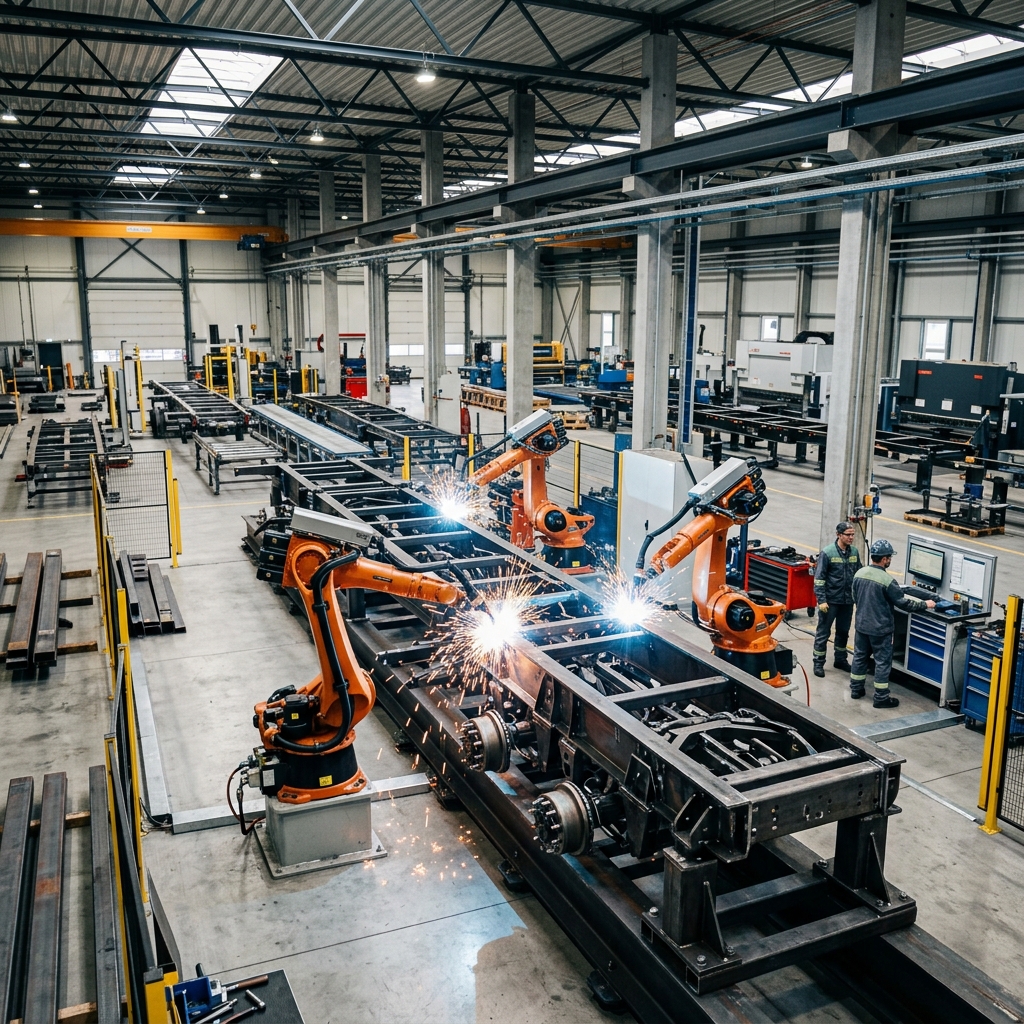
Quality is not checked at the end; it is built in at every stage. We follow a detailed standard operating checklist for every component.
We verify steel batch test certificates for yield strength, elongation, and chemical alloy elements before fabrication.
Critical load-bearing weld seams on main beams undergo ultrasonic inspections to identify internal weld voids.
We perform pneumatic pressure hold tests to detect air leaks in ABS braking lines, keeping response times under 0.2 seconds.
Tandem and Tridem axles are laser-aligned to prevent uneven tyre wear and ensure straight tracking behind the prime mover.